Springtails vs Isopods: Which Clean-Up Crew Do You Need?
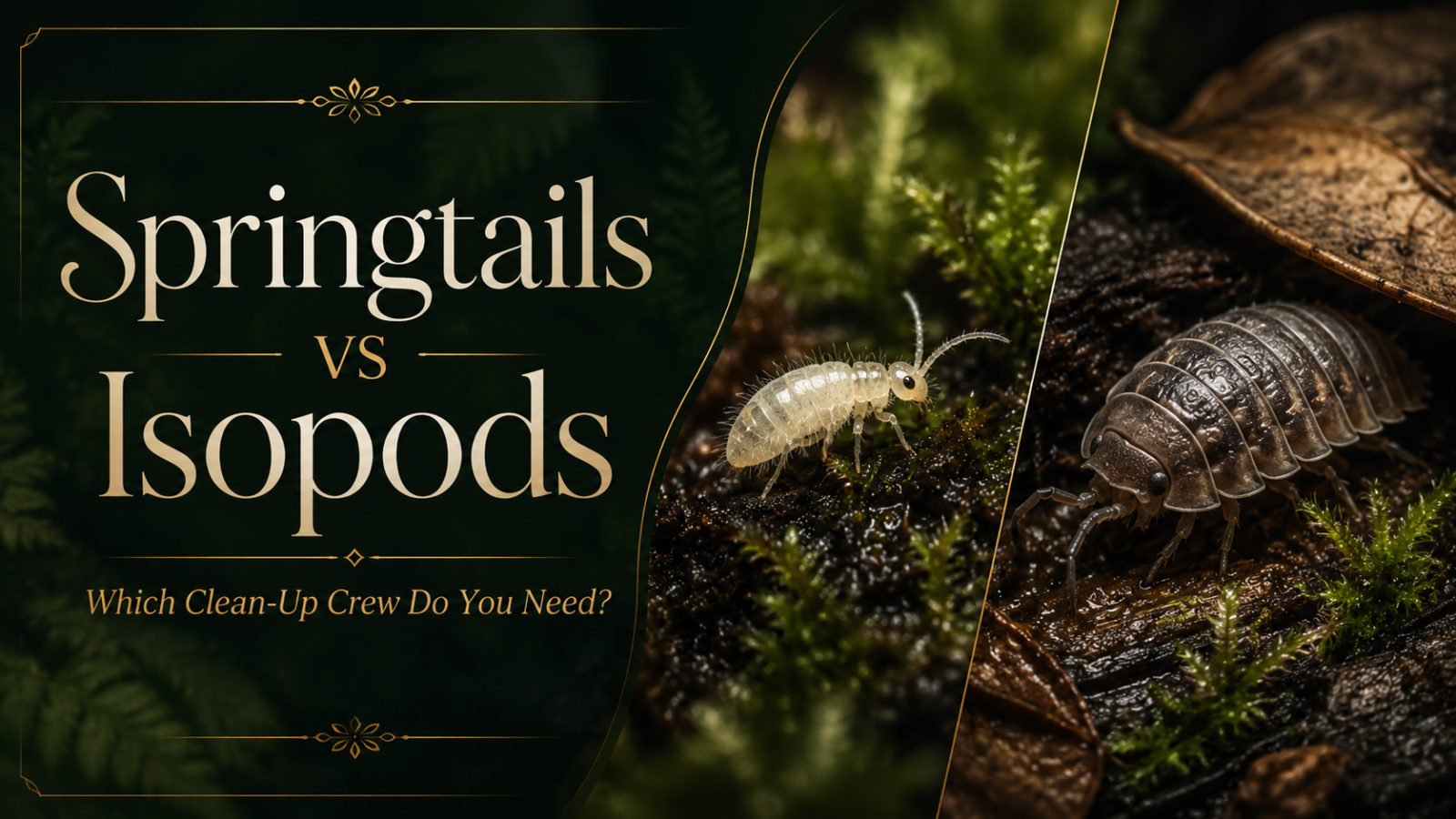
Springtails and isopods are the two core members of a bioactive clean-up crew, but they do different jobs: springtails are tiny mould-grazers that keep the surface and microclimate clean, while isopods are larger detritivores that break down leaf litter, wood and waste. Most successful bioactive vivariums use both — they complement each other rather than compete.
If you’re building your first bioactive setup, choosing a clean-up crew can feel confusing. This guide breaks down exactly what each one does, how they differ, and how to decide what your enclosure needs.
What’s the difference between springtails and isopods?
The simplest way to think about it: springtails handle the small stuff, isopods handle the big stuff. Springtails (Collembola) are tiny — usually 1–3mm — and reproduce extremely fast, swarming the substrate to eat mould, fungi and decaying matter before it becomes a problem. Isopods (woodlice) are far larger — 5–20mm depending on species — and slower-breeding, working through leaf litter, rotting wood, animal waste and leftover food.
| Springtails | Isopods | |
|---|---|---|
| Size | 1–3mm | 5–20mm |
| Main job | Mould & fungus control | Breaking down leaf litter & waste |
| Breeding speed | Very fast (weeks) | Slower (months) |
| Visibility | Mostly hidden / surface | Often seen, some kept as display |
| Best for beginners? | Yes — easiest first step | Yes, but establish more slowly |
| Calcium needed? | No | Yes (cuttlebone / limewood) |
What springtails do in a bioactive vivarium
Springtails are the first responders of a bioactive enclosure. Because they reproduce so quickly and feed primarily on mould and fungi, they keep new substrate and décor free of the white mould blooms that appear in the first few weeks of a fresh setup. They also graze on decaying plant matter and leftover food, and many reptiles, amphibians and invertebrates eat them as a tiny supplementary food source.
They’re the easiest place to start — a single springtail culture seeds most enclosures, and within a few weeks you’ll have a self-sustaining population. New to them? Our Springtail Care Guide covers housing, feeding and breeding.
What isopods do in a bioactive vivarium
Isopods are the heavy lifters. They process the material springtails can’t — whole leaves, bark, rotting wood, frass and animal waste — converting it into nutrient-rich frass that feeds your live plants and helps aerate the substrate as they burrow. Some species, like Cubaris “Rubber Ducky” or “Cherry Blossom”, are also kept as eye-catching display animals in their own right.
They breed more slowly than springtails and need a calcium source and a humid area with good ventilation. Browse our isopods for sale, and read the Isopod Care Guide for housing, leaf litter and calcium advice.
Do you need both springtails and isopods?
For a fully self-sustaining bioactive vivarium, yes — the two work best together. Springtails control mould and the microclimate; isopods break down the bulkier waste they can’t manage. Used together they cover the entire decomposition cycle, which is why most keepers add both. They don’t compete or harm each other, and isopods do not eat springtails.
If you want to start with one, begin with springtails — they’re cheaper, faster to establish, and immediately useful for mould control. Add isopods once the enclosure is settled. The simplest option is a combined starter culture pairing, which gives you both from day one.
Best clean-up crew for popular setups
- Dart frog vivariums: tropical springtails (essential, also a food source) plus a small tropical isopod like Dwarf White or Powder Orange.
- Leopard geckos: springtails plus a hardier isopod such as Porcellio scaber that tolerates a drier setup.
- Crested geckos: tropical springtails plus Dwarf White or Powder Orange isopods for a humid, planted enclosure.
- Tarantulas & inverts: springtails for mould control; Dwarf White isopods where extra waste breakdown is needed.
Not sure how to put it all together? Our Bioactive Vivarium Guide walks through building a balanced clean-up crew from scratch.
Frequently Asked Questions
Yes. Springtails and isopods live happily together and complement each other — springtails handle mould and the surface microclimate while isopods break down larger waste. They don’t compete for the same food and isopods do not eat springtails.
Add springtails first, or both at the same time. Springtails establish within a few weeks and immediately control mould in a fresh setup, whereas isopods take longer to build a colony, so getting them in early gives them a head start.
Springtails are far better for mould. Mould and fungi are their primary food, so a healthy springtail population clears the white mould blooms that appear on fresh substrate and wood. Isopods help with larger decaying matter but are not a mould-control specialist.
No. Isopods are detritivores that feed on decaying plant matter, wood and waste, not on live springtails. The two species coexist peacefully in the same enclosure.
Springtails are the easier and cheaper starting point — they establish in weeks and need no calcium supplementation. Isopods are still beginner-friendly but breed more slowly and need a calcium source and a humidity gradient.
Ready to build your clean-up crew? Shop healthy, UK captive-bred springtails and isopods from Bioactive Bugs UK, with fast UK delivery.