Display Isopods vs Clean-Up Crew Isopods
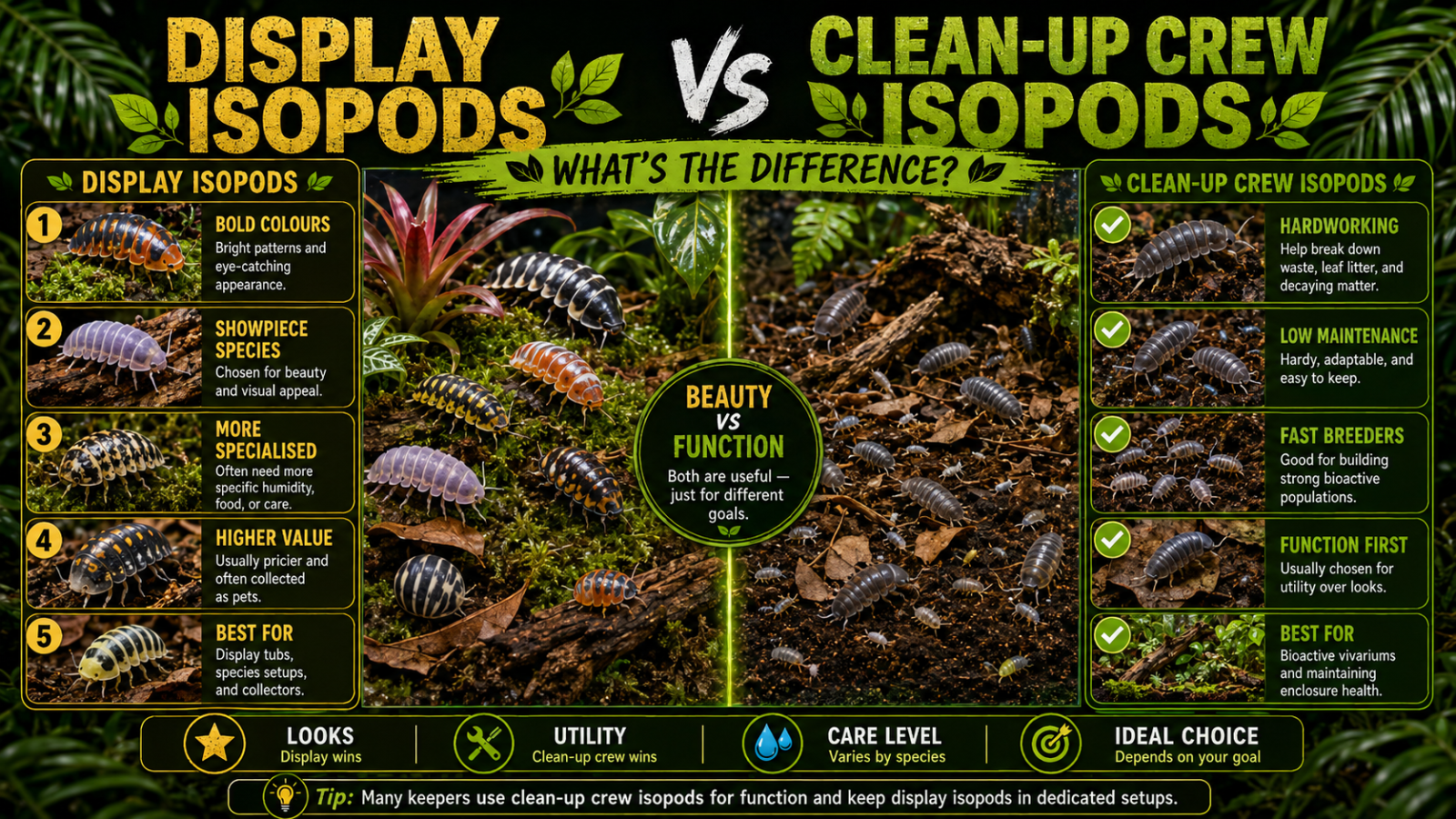
Not all isopods are kept for the same reason. Some are chosen purely for their practical role processing waste in the background of a vivarium, while others are prized for their striking colours and patterns and kept as a feature in their own right. Understanding the difference can help you choose the right species — or combination of species — for your setup.
What Are “Clean-Up Crew” Isopods?
Clean-up crew isopods are chosen primarily for function. They tend to be:
- Fast breeding — so the population can keep pace with the waste being produced.
- Hardy and adaptable — able to cope with fluctuations in humidity, temperature and food availability.
- Inexpensive and widely available — so colonies can be started cheaply and topped up easily.
- Often plain in colour — species like Dwarf White Isopods or wild-type Porcellio scaber are not especially decorative, but excel at their job.
These species are typically added in larger numbers and left to establish themselves throughout the substrate, where they’re often barely seen — which is exactly the point.
What Are “Display” Isopods?
Display isopods are chosen at least partly for their appearance. Many of the same species used as clean-up crews have selectively-bred colour morphs that have become popular in their own right — for example:
- Porcellio scaber ‘Dalmatian’ — a striking black-and-white speckled morph of the common rough woodlouse.
- Cubaris sp. ‘Rubber Ducky’ — a bright yellow/orange Cubaris species popular with collectors.
- Armadillidium gestroi ‘Montenegro’ — a glossy, ornately-patterned pillbug species that rolls into a ball when disturbed.
These species are often kept in smaller, dedicated enclosures (sometimes called “isopod condos”) where their colours and patterns can be appreciated up close, rather than as a working clean-up crew buried in a busy vivarium.
Can You Combine Display And Clean-Up Crew Species?
Yes — and many keepers do exactly this. A common approach is to use a hardy, fast-breeding species like Dwarf White or Powder Orange Isopods as the primary clean-up crew throughout the vivarium, while adding a small population of a display species (such as Porcellio scaber ‘Dalmatian’) to a visible area like leaf litter near the front glass, where they can be appreciated without competing too heavily with the main clean-up crew.
One thing to be cautious of is mixing isopod species in smaller, fully-enclosed setups — some species can outcompete others for food and space over time. In large bioactive vivariums with plenty of leaf litter and microhabitats, mixing is generally lower risk, but always research the specific species you’re combining.
Choosing The Right Species For Your Goals
Ask yourself what you actually want from your isopods:
- If your priority is a low-maintenance, self-sustaining clean-up crew that you’ll rarely see — go for a hardy, fast-breeding species like Dwarf White or Powder Orange.
- If you want a colourful focal point and don’t mind a bit more attention to husbandry — a display species like Porcellio scaber ‘Dalmatian’ or a Cubaris morph could be a great fit.
- If you want both — combine a hardy background species with a smaller population of a display species in a visible area.
Read More
For full housing, feeding and breeding information for all isopod species, see our Isopod Care Guide, or browse our full range across Beginner, Intermediate, Display and Rare Species.